Showing posts sorted by relevance for query pockets. Sort by date Show all posts

Thursday, April 9, 2020


FUN POCKETS FOR MY EASY AGELESS COOL SHIRT

I promised you a blog about the pockets I put on my Easy Ageless Cool shirt, so I'm back to explain those to you.  I used the same basic technique for both pockets, and you can create endless variations of them.

Of course, they can be any size you want them to be.  Draw a rectangle for the size pocket you want, including the 3/8" seam allowances on all 4 sides.

The fun is choosing the fabrics.  You'll want a large piece for the body of the pocket, a piece as wide as the pocket but about 3 inches (plus seam allowances) deep to act as the pocket facing, and a third piece about 2" deep as a trim piece.  
POCKET FACING
 
Place the pocket piece wrong side down on top of the facing piece, with the facing piece right side up, like this.  I have them folded back just so you can see the right and wrong sides.


Pin the pocket and facing together across the top edge.  Stitch them together across the top and grade the seam allowances, like this.


Press the seam allowances open.  Using a Pressing Template, press a 3/8" hem across the free edge of the facing.


Wrap the facing around the seam allowances and turn it down so it lies on the right side of the pocket.  This will prevent any of the pocket wrong side from peeking out at the top of the finished pocket.


POCKET TRIM
 
Fold the trim piece in half, wrong sides together, and lay a strip of Steam-a-Seam across it next to the raw edge.  Press it lightly and remove the paper backing.


Slide the trim piece under the pocket facing just enough to cover the Steam-a-Seam.  Press again to fuse.  At this point, you could also slide a strip of Steam-a-Seam under the trim piece, right under those same raw edges.  Press lightly again, remove the paper backing, and press to fuse.


Now you can stitch across the bottom of the pocket facing, attaching both the facing and the trim piece to the pocket.


ATTACHING THE POCKET
 
Staystitch both sides and the bottom of the combined pocket/facing/trim at 3/8".  Using a Pressing Template, press a 3/8" fold on all sides of the pocket, favoring the staystitching a thread or two to the wrong side.  Lay strips of Steam-a-Seam on all 3 folds, press lightly, and remove the paper backing.  Position your pocket on your garment and press again to fuse.  Be sure the seam allowances at the top corners are tucked down into the pocket slightly so they won't show when you're finished.


When everything is fused correctly, you can edgestitch your pretty pocket to the garment.  Be sure to stitch across the top of the pocket for 3/8" to catch the seam allowance at the top corner.  Count the number of stitches across at the top corner (usually about 4), then continue stitching around your pocket, using the appropriate presser foot.  End by stitching across the other upper corner with the same number of stitches as you used on the first top corner.  And ta-da, a terrific pocket!!


I only stitched my sample pocket 3/4 of the way around so I could show you that photo of the 3/8" folded back.  But the following photo will show you the thread tail where I started at a top corner.  


 One of the things I love to do is use strips of selvedge like this as my trim piece.  I just cut them wide enough so that their raw edge will fit under the pocket facing.  So save those selvedges!  Many have the circles of all the dye colors used to print the fabric, and some have lettering or other decorative motifs that would look great on a trim piece.


So there you are, everyone.  Have fun making distinctive pockets, and post them on the Facebook Forum for everyone to see.  Sharing feeds creativity for all of us. 

Tuesday, April 7, 2020

FABRIC COMBOS

Hi fellow sewers,

Because we've posted so many new Ends of Bolts on the website, I wanted to add another idea about combining fabrics to the suggestions I posted in the newsletter and on the Home Page.

In those spots, I showed you garments you could make from a short piece of fabric like an End of Bolt.  For instance, make a shell or even the pencil skirt from the Putting It Together pattern.  

I also showed you patterns that are intended to use more than 1 fabric, like Pick Stitch Perfect.

MY FABRIC COMBO SHIRT

What I'd like to show you today is a shirt made from the Easy Ageless Cool pattern.  Typically, this relaxed campshirt would be made from one fabric.  But I had a small stack of fabric leftovers that I didn't want to discard, so I put on my thinking cap and considered what I could do with them.

USE ONE FABRIC FOR EACH GARMENT PIECE

Here's the result of my brainstorming.  I cut each front out of a separate fabric and combined 2 fabrics to make the collar.  I also used different fabrics for each pocket.  Another fabric made the front facings.  The sleeves were cut from the same fabric as the left front.  

I made some of my decisions based on how much of each fabric I had.  That pocket on the left front used all but a few threads of the fabric scrap I had!


 COMBINE FABRICS TO MAKE A GARMENT PIECE

In the back, I was forced to take a different approach.  I laid out the remaining pieces of fabric and decided what looked good where.  I straightened all the edges with a ruler and rotary cutter, then began sewing the pieces together.  Once I had a large enough block of combined fabrics, I laid the  pattern piece on top and cut out the back.  Here's what that looked like when done:


A couple more views so you can see the entire back:


I really had fun playing with the pockets.  Here are their close-ups:


 MODIFY THE COLLAR

If you've used our patterns for a while, you know that our collars are cut as 1 piece, on the fold.  That means the entire collar must be cut from one fabric.  But-of course!-I didn't want that.  (Nothing like looking for trouble.)  So I traced the collar pattern.  Let's look, then I'll explain.


On the left side of the photo, the original pattern says, "Center back on fold." I added a 5/8" seam allowance there.  I also traced the pattern and added a 5/8" seam allowance in the same place.  The seam allowance is already included on the other end of each pattern.  Now the 2 pieces can be sewn together on both ends to form a complete collar which you can finish according to the instructions in the pattern.

THOSE POCKETS

Start digging through your stash for those small, special pieces of fabric you've been treasuring.  An End of Bolt from the website could give you a headstart.  Put together a plan to make your own combined-fabrics garment.

I'll post another blog in a couple of days to explain in detail how I made the pockets on my campshirt.

I hope that I'll soon start seeing the garments you've made from combined fabrics.  Post them to the Facebook Forum and let's do some distance celebrating! 


Monday, December 9, 2019

We had a request for more information recently.  Someone had seen this photo of a shirt and vest and had some questions, so I thought I'd let you know about the thought process and sewing techniques that went into it.


First, this shirt and vest were made from the By Popular Demand pattern, using the jacket pattern pieces.  
For the shirt, I obviously omitted the jacket's pockets.  I also lengthened the pattern by about 3" so that the orange shirt would show not only at the sleeves but also at the hem.

For the vest, I left the pockets off again.  I shortened the collar by 3/8" so that a rim of orange would show above the blue vest collar when the outfit was worn.  Of course, I left off the sleeves, which meant that I needed armhole facings.  Below, I'll show you how I came up with those.  

Finally, I used 2 threads through the needle to make really prominent orange edgestitching and topstitching on the vest to further tie the outfit together.  I wrote an explanation of that stitching technique in the third blog published in June 2019.  You can find it by clicking on June on the right hand side of the page.

Drafting an armhole facing pattern piece is pretty simple.  Begin by pressing the Front, Yoke, and Back pattern pieces for the jacket.  Use a dry iron on a low temperature.  That gets the pattern pieces to lie flat and ensures that your work will be accurate.  Then overlap the pieces at the shoulder and at the back/vest seam by 1-1/4" (2 seam allowances).  (Ignore the other alterations I've done on these pattern pieces.)


Lay a piece of tracing paper (I use medical exam paper--it's cheap and works fine) over the armhole area of the overlapped pieces.  

Using a fashion ruler, trace the armhole edge of the overlapped pattern pieces.  Also, mark the front armhole clip.  Be sure to also trace the top of the side seam edges.


Move the tracing paper away from the pattern.  Decide how wide you want your armhole facing to be, then add 5/8" for seam allowances.  In this example, I used a total width of 2-5/8", which will result in 2" wide facings.  

Use a seam gauge to mark the width of your new armhole facing.  In the illustration below, note how I have positioned the seam gauge so that both sides of the little blue tab (slide) are lying on the traced line.  Making the seam gauge extend straight out from the original traced line ensures that the facing will be the same width everywhere.  Make marks as you move the seam gauge along the facing.


Using a fashion ruler, connect the marks in a smoothly curved line.


Be sure to mark the front and back of your new facing pattern.  (Now you can see that front clip.  I had to reposition the facing on the Front to mark it.  You can do it in the first step above, when I mentioned it!)


You can adapt many shirt and jacket patterns to make vests using this technique.  Have a good time!


Monday, December 21, 2020

Hello everyone,

Well, wouldn't you know!  The other day, Louise and I were talking about which fabrics we should feature next, when she came up with another interesting idea.

Recently, we've been working with boiled wool, and we published our pdf called "Give a Little, Take a Little" about how to use special techniques to create garments with that wonderful fabric.  Louise said, "Let's use those techniques with denim and let the raw edges fray." 

 So I did a couple of little samples to see how it looked, and I liked it.   Below, I'll show you how I made these samples of overlapped seams with frayed edges.  If you'd like to make a complete garment finished with this great look, you might want to download "Give a Little, Take a Little" from the website.

I cut small pieces of denim and stitched 5/8" from the cut edge to give myself a guideline.  I applied a strip of Steam-a-Seam to the edge, leaving a bit of room next to the stitching.  I didn't want to glue the very edge of the piece I would apply on top, because that would prevent the overlapped edge from fraying.  And the fraying was exactly what I wanted. 

By the way, if working with boiled wool, don't use Steam-a-Seam.  We have double-sided sticky tape, which works better on the boiled wool.

I made 2 samples.  In the photo, the paper backing was still on the Steam-a-Seam so you could see it clearly.

Next, I removed the paper backing and lapped another piece of denim on top so that its cut edge just barely hid the stitched guideline (it's in gold thread above).  Of course, if I had been making a garment rather than a sample, I would have cut off 5/8" from this second edge to maintain the proper amount of fabric taken up in the seam.  Details are in "Give a Little, Take a Little". 
 

You can just see the gold thread of the stitched guideline peeking out of the bottom of this sample above.


Press with your iron to fuse the layers.  These seams are easy to handle now because the Steam-a-Seam is holding them. 

It's time to stitch.  I moved my needle to the left of center and used an edge-stitching foot to sew the first line of stitching.

I changed to my general purpose foot, lined up the edge of the fabric with the edge of the foot, and stitched a second line.  This photo shows the relationship of the Steam-a-Seam, the stitched guideline underneath, and the 2 lines of topstitching.


Fortunately, I needed to do a load of laundry, so the samples went in with everything else, taking a spin through the washing machine and the dryer.  When they emerged, I pressed them lightly and took photos.


This was my initial experiment and it showed me that the technique could be a success.  I could see this around the edges of pockets, as a seam finish, around the edges of a collar, and down the front of a garment on the joined facings/garment fronts.  

I think I'd like it even better if my first line of topstitching had been just a few threads further from the cut edge, letting just a bit more fraying take place.

Give this a try.  It's fun to play around.  Be sure to make samples first--mine only took a few minutes.  That way, you'll be sure to get just the look you want.

This is one of the gifts of sewing.  You get to create your own distinctive look while you relax and play with fabric.  Have fun!


Wednesday, July 31, 2019

Hi, everyone,

I've missed you!  We've been working on a project that we hope you'll be seeing soon.  In the meantime, I thought I'd shed a little light on a simple technique and share a reminder that a pattern is just a starting point for your individual design sense.  

Let's see what that means.  Louise found this coat online (by Gudrun Sjödén) that looks so much like our Anything But Ordinary jacket made longer.  She posted it on the Facebook Forum as inspiration for anyone who might be thinking that she'd like a cute coat this fall.


It's a good reminder that we are our own designers.  So you can choose a jacket pattern, make it longer, and proceed with your own coat.  Choose the fabric, the length, the details, the buttons that you want.  You'd never find that particular combination in a store.

Anything But Ordinary pattern
Notice the similarity between the coat's collar and the collar in the pattern.  This could be made any length and from a lightweight to a heavier fabric---so start imagining.

So here are a few tips about lengthening patterns.  Of course, it's a simple thing, but like anything else about adjusting patterns, it helps to do it accurately.  So here's what I do.

First, I iron the pattern with a warm, dry iron.  No steam--ask me how I know!  I can't get good results if there are wrinkles.


Then I cut the pattern on the lengthen/shorten line, obviously.  (You do have to consider whether that would interfere with pockets, etc. so you could draw a line in another spot if needed.)  Then I slide tracing paper (from a medical supply store; it's really the stuff on the doctor's exam table) under the cut edge of the upper Front.


I won't tell you how many years it took for me to realize that taping the pattern to the tracing paper is so much easier if I lay a ruler right beside the edge I'll be taping.  That way, the pattern tissue doesn't fly up and get stuck on the tape with lots of wrinkles in it.  Ever happen to you?

So if I want to add 2 inches to the length of my jacket, I'll use my ruler to draw an accurate line 2" below the lengthen/shorten line.  But I also continue some relevant vertical lines, like the grainline, center front line, perhaps a foldline.  That way, I can align the bottom portion of the pattern exactly in the right place.


Here, I have the lower part of the pattern below its final placement, just so you can see the lines I drew for the alignment.  

Finally, I tape the lower part in place, using the ruler to hold the edge of the pattern tissue down again.  


They're all such simple steps, but I spent years fiddling with trying to place both pattern pieces before I taped anything down, then using little bitty pieces of tape so I didn't wrinkle everything up.  The extra alignment lines and the ruler placed before taping have just helped avoid so much frustration and ensured accuracy.

One student who attended a retreat with us, and who evidently had the same frustrations, said that the ruler trick was "worth the price of admission."  

So who's ready to start making a coat?  If you do, email us a photo when you're done or post it on the Facebook Forum.  I'd love to see your work.  You can email me at 
sandy@cuttinglinedesigns.com with questions or suggestions for topics. 

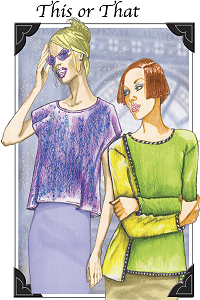
I'll be teaching a class in September to show you so many variations on the simple idea of the Boxtop in This or That.

Here's the pattern:

 This or That pattern

And here's my winter variation, a snuggly, warm, sweater-like version to layer over another top.  See the Events page for more details.  I'll be adding more ideas shortly.


.


Monday, June 24, 2019

CREATING A WARDROBE

A few years ago, I filmed a DVD (How to Sew a Travel Wardrobe) about creating a wardrobe for Threads Magazine, and we followed up on that idea with an article in the magazine (Feb/March, 2016).  As I was writing the article, I quickly set up some outfits on a mannequin in my studio and took photos.  I thought you might like to see those photos, so I'm posting them here.

In these first photos, I'm showing you how one top can coordinate with different pairs of pants (or skirts).  It's helpful to begin with a couple of neutral colors, then branch out.  


This is the Ebb top from the Ebb and Flow pattern.  It's made in an off-white rayon, so it's soft and drapes beautifully on the body.  Here, it's shown with One-Seam Pants in black and white houndstooth check.  The top's color is versatile, so I'll show you how it can be worn with other pants.  Note the necklace to bring black up to the top of the outfit, making the whole look coordinated.  Also, the buttons match the color of the top, adding to its versatility.


Staying with the black and white idea, here's Ebb again with a neutral pant and the Artist in Motion vest in black.  This vest was made in a soft wool, but rayon or another drapey fabric would also work well.  It's so much fun to make and wear, as it is one-size-fits-all and only 2 pieces to assemble.  And, of course, this vest would also pair with the Ebb top and the black and white houndstooth check pants in the previous photo.


Here's the Ebb top once again with My Swing Set pants made in a gold-glazed linen.  Note that I changed the necklace.  This one looks good but was quite inexpensive; it is just that "third piece" that completes the look.


Here are the same gold-glazed linen pants.  This time they are paired with a top in a printed linen.  It's a modified version of the top from Anything but Ordinary.  Louise calls it her "go-to" top.  You can find out how she makes it on our Facebook Forum.  Notice that the background of the print is a neutral color, but the print contains blue, green, red, and yellow--all colors that could show up in coordinating garments.


And here's the Ebb top again with a pair of blue linen One-Seam Pants.  The "go-to" top from Anything but Ordinary in the previous photo could also be worn with these pants.  

Let's see where we can go from here.


I made a shirt/jacket from the Take Me Anywhere pattern in the same blue linen.  Now I have a 3-piece outfit.  Remember that the printed "go-to" top could also work here--so 2 outfits.  

Where can we go from here?

Well, we can pair the shirt/jacket with the pants and wear those 2 pieces as an outfit.  A scarf in a print that contains some blue would accent this beautifully.  Scarves make great vacation souvenirs! 

Can we take this a step further?  YES.


The same outfit (shirt/jacket and pants) with the "third piece", which is now a vest from the Discover Something Novel pattern.  The vest makes this a more casual but coordinated outfit.  

Plus, the vest contains both off-white and black.  It could be the "third piece" when combined with the off-white Ebb top and the black and white houndstooth check pants.  It could also work well with the off-white Ebb top and the blue linen pants.  

We had some white linen in the warehouse, so . . . . . .


I made a top from the Just My Style pattern in white linen, with blue buttons on the pockets to coordinate with the pants and shirt/jacket.  The Discover Something Novel vest could go over this white top, since its printed fabric also contains white.

I hope I've given you some ideas for beginning with a couple of garments in neutral colors that work together, then finding a print that contains both your neutrals as well as some accent colors, allowing you to branch out.  Quick, go dig around in your stash and see what you can come up with!!

If you have questions or suggestions for topics, please contact me at sandy@cuttinglinedesigns.com.  I'd love to hear from you.